Showing posts with label Dutch wax prints. Show all posts

Friday, November 18, 2011

Nuts and bolts of wax resist

Vlisco

A comment from Renée reminded me that I had not explained the wax technique in my post, Wonderful Wax.

Vlisco
Wax fabrics are industrial products that were originally inspired by Javanese batik. The method of making them falls under the heading of resist dyeing techniques. As in printing, an engraved roller is used to apply pattern to the fabric, but in this case, it is melted wax that is rolled on to the surface. (Traditional batik calls for  a tjanting tool - a sort of pen filled with hot wax for drawing directly on the fabric.)
The fabric is then dyed and because the dye cannot be absorbed by the areas covered with wax, a negative pattern is created. The process of applying patterns of wax and dyeing can be repeated to make a design of several colors.

Vlisco
The Vlisco site explains :

The core element in Wax Print is of course the wax. Using two deep engraved copper rollers, with the mirror image of the design, the two sides of the cotton fabric are printed with a pattern of melted wax, hence the name Wax Print. The fact that the cloth is printed on both sides enables you to wear the product either side. This is the true sign of a quality wax print. Following this, the cloth is immersed in a bath of dye, often Indigo, that penetrates into the areas that are not covered with wax. After the wax as been washed off in varying stages, a negative image of the printed pattern remains on the cloth. This intricate wax printing process results in unique effects that makes the product so outstanding. In fact, not one single centimetre of fabric is identical to the other!

Vlisco

 I usually buy my "Wax Hollandais" at Toto where these fabrics are sold by weight, 

Vlisco

but much greater possibilities are offered on-line.


Vlisco

This post isn't an advertisement for Vlisco, but it's hard to resist the occassion to show more of their designs!
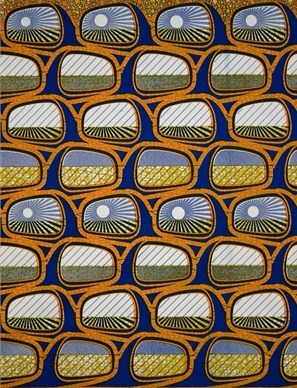
All these Op Art style patterns are from the new collection, Delicate Shades.


Monday, November 7, 2011

Wonderful Wax


Vlisco

The wax paradox: what could be more typically African than wax print fabrics made and designed for over 150 years in Holland or England?  How is it possible that Africa,  a country so rich in diverse textile traditions, has so strongly identified itself and been identified by other nations with these imported textiles? The wax prints we know today started out as mass-produced imitations of Javanese batiks in the beginning of the 19th century which ended up with West Africa as its strongest market.

Vlisco

Anne Grosfilley is an anthropologist whose thoughtful and informative book, Afrique des Textiles offers many insights on the subject as well as covering the whys and hows of locally made African textiles today.  She explains, "An understanding of wax fabrics leads to the discovery of how a fabric from abroad, from Europe in this case, became an essential element in the west African textile landscape. It also means recognizing how the history of relations between Europe and Africa has been recorded through fabric since the colonial period. Long before wax prints became identified with Africa, they were cloths of otherness, a white person's view of black populations, a Westerner's projection on the African world." 

Vlisco

 Once distributed in West Africa today, these prints fall into the hands of the  mostly female wholesalers who give each fabric a name to truly adapt it to local clientele. The right name can multiply the article's price up to 5 times, if the demand is strong enough. Anne Grosfilley says that relating a fabric to a political or television celebrity is a means of identification and cites a design with small ovals which was given the name "Z'ongles de Madame Thérèse" ( Mme Therese's nails), named for the then Ivorian president Boigny's wife.   A rumor at the time had spread that the president had a mistress and that Mme Boigny would surely claw her face if she caught her. Wearing this fabric became a way of showing oneself to be a strong woman who was not submissive to her husband.  The economic re-appropriation of these goods is no longer just a means to enriching certain women, but has become a social phenomena.


This recent design is named Michele's handbag.

Burberry Prorsum resort 2012
via IBTimes
These past few years, European high fashion has also adopted these prints with all their colorful creativity. I  recently spotted Franck Sorbier buying a roll of geometric wax prints, 

Vlisco

so  presumably we will see more of this trend on the horizon.

Vlisco

The manufacturer of  the most appreciated by the African diaspora today is the prestigious Vlisco whose site is always a joy to visit. The numerous designs take you into a world of unbridled fantasy that tend to make everything else feel humdrum. If you are not familiar with them, take a look at the great variety of designs and  remember that their scale...


Vlisco
is often much larger than you may realize. 

Vlisco


Vlisco


For an interesting article on wax prints, click here