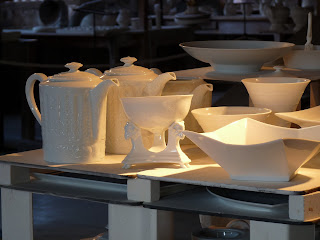
My husband tells me that there used to be a jingle for Bernardaud that still comes to mind for a lot of people. It sums up the essential -- Bernardaud, Limoges ancien, Limoges contemporain... (see below).
I know I love both old and new styles and mixing both. Why limit ourselves? A post by The Peak of Chic a few weeks ago discussed how porcelain was sometimes thought of as fussy and then went on to prove the contrary with fabulous objects from the Nymphenburg Porcelain Manufactory in Munich. That post inspired a trip to the manufacture Bernardaud at Limoges last week. The lastingness of these proud porcelain manufacturers lies in their willingness to evolve with the best of the times in terms of art and technique and never to lose their traditional savoir-faire. Bernardaud dates only to the mid 19th century, but incorporates the Ancienne Manufacture Royale Limoges founded in 1797. It is particularly known as dynamic family enterprise and for close association with artists and designers of the day.
 Plates by Kees Van Dongen 1950s; tea service by unmarked designer
We all know the name Bernardaud, but do we realize how inventive and closely tied it is to the art world? Kees Van Dongen, César, and Bernard Buffet count among Bernardaud's illustrious designers. In 1952, Marc Chagall signed a service, each piece with a different decoration. Raymond Loewy, Franco-American industrial design guru, created a revolutionary table service in 1967, mixing round, oval, and angular shapes. Later came painter Zao Woo-Ki and Hervé Van des Straeten, India Madhavi, Olivier Gagnère...
Porcelain making is one of the fascinating arts of fire, along with glass and metal working. It's not a wonder that many of today's designers with sometimes no special background in porcelain, are taken by it and wish to explore all its possibilities.
Olivier Gagnère, whose work is well known in ceramics, glass, furniture and interior design, already has a certain body of work with Bernardaud. He speaks of the magic transformation that takes place in porcelain and glass making and admits that working with these materials requires a lot of humility and patience. He is probably most known for his peppy striped tabled service, Galerie Royale.

 Song vase by Olivier Gagnère
 Cul vase by IBU (Irena Borzena Ustjanowski)
 from the Al Dente Collection designed by Marco Mencacci
 Tasses 1000 by Designers 5.5
(Vincent Baranger, Jean-Sébastien Blanc, Anthony Lebossé, Claire Renard)
These limited edition cups are playful -- imagine getting your hand around them for a surrealistic tea party!

Couronne vase design Martin Szekely

Anno cup design by Sylvain Dubuisson
Anno cup design by Sylvain Dubuisson
 Salsa cup 50s style with sits with spinning effect on its saucer. Unfortunately, I couldn't find the designer name.
Pensées
 Boulle inspired by the marquetry of the 18th century cabinet maker
Paradis tray
 Diam plates, Loop cup design Christophe Pillet
 One ring and Forever necklace are part of a large selection of jewelry that is well-distributed.
See more at Bernardaud and explore all sorts of historic pieces atAdrien Dubouché the porcelain museum of Limoges.


 Each piece is fired at least twice. One 24 hour passage in the kiln strengthens and makes the piece porous. This is bisque firing. After the piece has been dipped into glaze to make it impermeable, next comes a second, extremely high temperature firing. The final tureen at right shows a shrinkage of 14%.