
Screens have divided and conquered Eastern and Western living spaces through the ages. With their distant origins in China dating to the 300B.C., their use became more widespread in the 7
th century China. First heavy, lacquered, relatively stationary objects, they became truly mobile when made of beautiful papers and cloths later in 8
th century Japan. Their easy transport made them ideal for tea ceremonies or as backdrops for religious ceremonies, dance and theatrical productions. The wild enthusiasm for all Oriental articles of luxury and refinement of the late 17
th early 18
th century naturally included not only
porcelains, lacquer furniture and silks, but also screens. It seems to me their introduction into Western living spaces altered our relation to those spaces.
( European illustration for a fan, 1700,Victoria & Albert Museum)
 This very simple screen made from a frame with dark green fabric nailed through a ribbon on to it seems to show that the utility of screens had been known for some time already; a screen wasn't only a highly ornamental piece from the Orient. Homemade would do. (Gérhard ter Borch 1665)
Mme
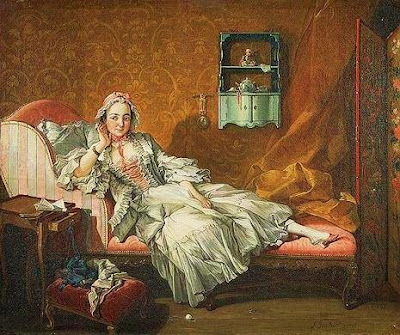
de Rambouillet (1588-1665) is thought to have first brought screens into fashion in France. Their introduction into living quarters coincides with the start of a new desire for privacy in a world where personal isolation was yet unheard of. Interiors were teaming with humanity. Aristocratic circles were surrounded by servants and constant social movement and in simpler home settings, one room served for everything and everybody; living was a collective venture. Folding screens could designate a more intimate space. Behind the protection of its shielding presence, one could listen and dream unseen. (Francois
Boucher 1743)
 Vast rooms would begin to be marked off with areas for particular domestic functions. The notion of comfort had started to make headway. Daybeds and low slung fauteuils encouraged a different kind of posture and less self-conscious behavior. One could set off precious chosen company as jewels in front of its richly decorated folds, the better to appreciate glittering banter or stylish readings. Luxury had met with a new sense of douceur de vivre, stiff etiquette could be relaxed here.
(Jean Francois de Troy 1679-1752)
 With the progression of the home to a personal sanctuary, privacy became more and more natural to the point of being taken for granted. The 19th and 20th centuries saw homes become increasingly the expression of their owner's personalities and this as a prerogative for many.
The use of screens on the stage has long been known as a simple way to change scenery. To those who approach life as an art form, screens seem an especially fitting accessory for the home. You have only to provide the theatrics before the backdrop of your choice. Here's quite an example to follow with Dame Edith Sitwell in this famous photograph by Cecil Beaton.
 Anna de Noailles, poetess with a flair for exotic costume. Many photographs show her with this screen positioned behind her daybed or her bed.
 It's so much more effective to strike a pose against the vibrant color of a Chinese screen - a method tried and true for us in Western interiors for 400 years. Women's magazines throughout the 19th and beginning of the 20th century were filled with projects for homemade screens using postage stamps, wallpaper, or prints - just as today we may see similar projects using stencils, photographs or storage pockets.
 André Arbus
 proves the utility of screens even in a very streamlined setting. There are no paintings on the walls but a screen of the same cream tones as the walls sets the accent on the sofa, giving it importance and a level of comfort that it would lack without it.
Click for more information on
screens

 Esse by Vittorio Livi for Fiam
 photo Bruno Jarret pour Maison Francaise


 Rita Phipps ( Ann Sothern) has been waiting for Deborah in front of her home in a neighborhood shared by those on their way up and those on their way down. "Rita is on her way up and wouldn't have it any other way," says the voice of Addie. She rushes back in to say goodbye to the twins, oblivious of her husband, George (Kirk Douglas).
 The beautiful Lora Mae (Linda Darnell) is from a shack on the wrong side of the tracks. It shakes and rattles when the train passes by but Lora Mae stays cool and steady for she knows what she wants...


 The cumbersome folding screen practically comes tumbling through the viewing screen,

 If you are in love with the worn and faded souvenirs of yesterday and sometimes feel your most at one with humanity when it reaches out to you from the bygone days ... you might enjoy my views of one of my favorite fairs on the Ile des Impressionists.
 It must be difficult to restore some of these.


 *Dedicates a space to a particular purpose faster than any other means. This screen and bed were designed by Hubert Le Gall in the tradition of fine lacquer work.
  *Hides what we don't want to be seen. A work area/office space, pipes, a sink or some unsightly but necessary element is tucked away from the general view. This
  *Provides an additional wall and protection from drafts. The French name for screen is
  * Stands on its own as an artwork.
 *Replaces shutters as mobile window dressing for windows that don't cry out for curtains.
 *Gives a bit of privacy to a dressing area. Think of all those
  Sometimes we aren't sure why they show up in an interior. They just happen to be
 A screen...
  *It furnishes lonely corners and balances out a decorative theme.


