
This is not a tale of cottages. No, the story begins in a certain château in Auvergne.
 |
| Wikicommons |
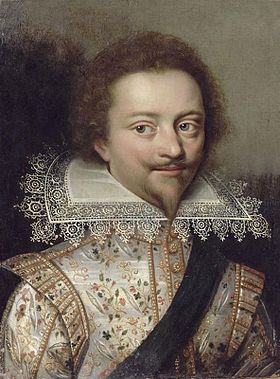
It was a proud dwelling built between 1626-28 by the Marshal of Effiat, Antoine Coëffier de Ruzé, counselor to Louis XIII and close friend of Richelieu.
His château held at three beds,
They were sold at auction in 1856, as were the rest of the furnishings that had managed to be keep intact until then.
Through my various explorations this way and that, I realized that I had seen all three of these beds and had photographed them, although my pictures aren't all of the same quality. I thought I would reunite the beds here and supplement better pictures where needed.
My story is a simple one. A document really. There are no indignant bears or sassy little girls - unless Time itself could be said to hold the role of Goldilocks!
 |
| photo:RMN Louvre |
The most famous of these beds is today in the département des arts décoratifs at the Louvre. It is the perfect example of the bed à la française or the lit en housse (covered bed) of the mid 17th century and one of the few beds to come down to us from the period with its original textiles. With its hangings of Genoa velvet down, it makes a cube and has the solemn air of a catafalque. Underneath all that exhuberant fabric, the bed posts are said to be uterly simple. The luxurious aspect of beds of this time owed entirely to their upholstery and trim. In fact if few of these marvelous beds have survived, it is because the precious textiles wore out and the plain wood, usually of no value in itself, was probably burned.
 |
| Abraham Brosse |
This engraving by Abraham Bosse shows the cords for raising the curtains - the 17th century gradually left the expression courtines behind for rideaux.
Otherwise tie backs were used to attach the curtains to the posts.
Otherwise tie backs were used to attach the curtains to the posts.
 |
| photo Cluny via Chest of books |
An early image shows the hangings parted but we don't see the headboard.
 |
| photo: jpbraud decoration |
It may have been like this one, Effiat bed No. 2 at the chateau of Azay le Rideau whose hangings have been beautifully reconstitued here.
These seem to be the original bed textiles found in Jacques Anquetil's book La Soie en Occident.
 |
| photo Marc Walter |
 |
| photo: Le style et la matière |
To quote Bill Pallot,
"Beds were greatly prized pieces of furniture in the 17th century
and as such described very precisely in inventories. Louis XIII had one
covered with purple damask and adorned with large gold embroidery, Richelieu
owned another with tapestry of white satin and gold embroidery and Mazarin
possessed several. Beds accompanied their owners in their travels. They were
taken apart and placed in leather trunks. Often monumental in size, they
were set in a corner of the bedchamber.
 |
| Abraham Brosse |
The space between the bed and the
wall was called the 'ruelle' (narrow street). This was where private
gatherings were held as it was customary to receive company at home while
lying in bed."
 |
| photo: Le style et la matière |
 |
| photo: Le style et la matière |
 |
| photo RMN |
Finally, my visit to the Musée de la Renaissance at Ecouen a few weeks ago permited me to see Effiat bed No. 3. Made in the late 16th century, it is the oldest of the trio but retains some 19th century modifications.
 |
| photo: Le style et la matière |
The hangings are not original and the curators plan to restore it to its 19th century state as it was presented by Sommerard at the Hotel de Cluny in what was called the
chamber of Francois I.
chamber of Francois I.
 |
| photo: Le style et la matière |
This ornately carved bedstead
has fine detailing on the foot posts
has fine detailing on the foot posts
 |
| photo: Le style et la matière |
and military cariatides at the head of the bed.
 |
| image: RMN |
This engraving of the Musée de Cluny depicts the brimming cabinet d'amateur atmosphere that reigned in 1840. There must have been some indecision as to how to assemble the posts. Here the cariatides have been installed at the foot of the bed rather than at its head.
I have seen other beds with four cariatides or atlantes, never only two as we see here.
 |
| © Léon et Lévy / Roger-Viollet |
Here, somewhat later but still at Cluny, the columns have been switched around in the way
which is today believed to be the correct assembly of the bed.
Cluny is now specialized in art and artifacts of the middle ages, Ecouen is the place to go for the
15-17th centuries which is why this bed is located there now.
 |
| photo: Le style et la matière. |
No pomme , no panache naturally, on this 16th century bed from Effiat at Ecouen,
but nearby in the textile department is displayed a vase-finial which looks very much like those on the later Effiat beds in the Louvre and at Azay.
From this angle, in a case, we get a good close look at its construction

and next to it is a charming miniature bed, once considered to be part of a doll house.
 |
| (C) RMN-Grand Palais Gérard Blot (musée de la Renaissance, château d'Ecouen) |
It is now recognized as an upholsterer's or embroiderer's maquette.
This is a model of a Duchesse bed
which really only became popular at the end of the 17th century.
Louis XIV himself prefered four posts.
****
For another article on beds and my own 17th century bed -
look here
It is carved with a commemorative date of 1601 and the initials I.V. and C.G..
The date probably refers to a wedding date.
One day I may find out just who I.V. and C.G. were...


